

INVESTIGACIÓN
Ana M. Núñez Remesal | Dr. Jesús García
El callar de la infancia
Resumen
Introducción: Los abusos sexuales en la infancia ocasionan un profundo daño psicológico y manifestaciones sintomáticas vinculadas al trauma. A pesar de que estos incidentes son objeto de estudio en la literatura científica, la evidencia sobre cómo la terapia gestalt contribuye a la elaboración del trauma es limitada. El propósito de este estudio es determinar si el enfoque gestáltico facilita dicha elaboración, evaluando los cambios en la resiliencia, la percepción del trauma, la sintomatología ansioso-depresiva y el cambio terapéutico.
Método: Se implementó la terapia gestalt a lo largo de 22 sesiones durante seis meses. Para el análisis cuantitativo, se emplearon dos instrumentos de medida para evaluar el efecto del tratamiento en el cambio terapéutico (CORE-SFA), la sintomatología asociada a la triada depresión-ansiedad-estrés (DASS21) y el trauma (PCL-C), utilizando índices de no solapamiento para verificar el nivel de cambio. El índice de cambio fiable de Jacobson y Truax (1991) se utilizó para determinar la significancia clínica, administrando escalas para el trauma (HTQ) y para la resiliencia (RS-14) antes y después del tratamiento. En cuanto al análisis cualitativo, se elaboró la Historia de Vida de McAdams en ambos momentos, analizándola según criterios de análisis temático.
Resultados: Los índices de no solapamiento evidenciaron cambios significativos en la sintomatología. El índice de cambio fiable reveló una mejora en la resiliencia. Aunque la puntuación general en la escala HTQ superó el umbral establecido, no alcanzó el índice de cambio fiable, aunque se observaron mejoras en tres de las dimensiones de contenido.
Discusión: La terapia gestalt demostró ser efectiva en este caso para reducir los pensamientos intrusivos relacionados con la experiencia traumática, incrementar la conciencia cognitiva y emocional sobre la experiencia de vida y promover una disminución de conductas evitativas y limitantes.
Palabras clave: abuso sexual, migración, trauma complejo, psicoterapia gestalt, resiliencia
Introducción:
Se presenta el caso de Esperanza, mujer migrante de 17 años que sufrió violencia sexual en la infancia y a lo largo de su trayecto migratorio desde África occidental. La violencia sexual —según la Organización Mundial de la Salud (OMS, 2014)— se entiende como todo acto sexual, la tentativa de consumarlo, los comentarios, insinuaciones sexuales no deseadas, o las acciones que utilizan la coacción de una persona frente a otra. La violencia sexual está causada por asimetrías de poder en la estructura social y constituye, por lo tanto, un problema de derechos humanos. Las mujeres son especialmente vulnerables (Kimy Kim,2020) y la mujer migrante, por sus características propias, lo es aún más. Estas pueden sufrir violencia sexual tanto en su país de origen como durante el tránsito o en el país de destino (Tan y Kuschminder, 2022).
El impacto emocional de la violencia sexual en la infancia varía en función del momento del desarrollo en el que se da el episodio, la frecuencia, si la persona agresora es conocida o no y la naturaleza de la violencia. Así, cuando la violencia ejercida es muy grave y no existe un adecuado apoyo, la probabilidad de sufrir sintomatología relacionada con el trauma es mayor (Sarasua et al, 2012).

En las mujeres migrantes, no solo subyace el trauma debido a estos episodios, sino que la situación de vulnerabilidad de la que parten —por su propia historia de vida, las experiencias traumáticas del propio proceso migratorio, y el riesgo de caer en la práctica de sexo transaccional— hacen que puedan desarrollar un trauma complejo, el cual presenta unas características diferente al trauma por estrés postraumático (Giorgio et al, 2016; Vallejo-Martin et al, 2021).

El trastorno de estrés postraumático complejo se caracteriza por la gravedad y la persistencia en los problemas de la regulación del afecto; la creencia de no tener valor, sentimientos de vergüenza, culpa o fracaso relacionados con el evento traumático y las dificultades para mantener relaciones y sentirse cerca de los demás. Estos síntomas causan un deterioro significativo en la esfera personal, familiar, social, educativa, ocupacional u otras áreas importantes del funcionamiento, según los criterios de la CIE-11 (WHO, 2018). Por tanto, el trauma no es sólo un acontecimiento que se produce en algún momento del pasado; también es la huella dejada por esta experiencia en la mente, el cerebro y el cuerpo, la cual tiene consecuencias permanentes sobre el modo en que el organismo humano logra sobrevivir en el presente (van der Kolk, 2014).
El deterioro en la esfera personal es una de las consecuencias del trastorno de estrés postraumático.
Desde esta óptica, la terapia gestalt (en adelante, TG), se presenta como un modelo idóneo de intervención que busca la integración de la experiencia en el conjunto de la vivencia de la persona (Yontef, 2009). La intervención se realiza sobre el campo relacional creado entre paciente y terapeuta, aumentando la conciencia y facilitando la autorregulación organísmica (Fogarty et al, 2016; Francesetti, 2015), desde el trabajo con la experiencia inmediata, el «darse cuenta» y la responsabilidad (Peñarrubia, 2006).
La experiencia inmediata tiene que ver con el espacio terapéutico, pues es allí donde se produce un encuentro íntimo y se ponen en juego las vulnerabilidades, tanto del paciente como del terapeuta (Chu, 2017). En este campo fenomenológico, se ayuda a la asimilación del evento traumático y se reduce la sintomatología, creando un clima de confianza y seguridad que permite sostener la angustia del paciente y favorece la expresión espontánea. Entre ambos se produce una relación horizontal, pero no simétrica. Existe asimetría en tanto el terapeuta lleva más años trabajando su carácter, lo que le dota de capacidad para facilitar el «darse cuenta» del paciente. El paciente sabe de su experiencia y el terapeuta ayuda a la toma de conciencia de ello, a que se responsabilice ampliando a nuevos registros y capacidades que le generen bienestar sosteniéndose en lo que hay (Yontef, 2009).
En la TP, la presencia requiere una inmersión total en la relación terapéutica, utilizando todos nuestros sentidos —ver, escuchar, oler, saborear, sentir nuestro cuerpo y respirar— en el «aquí y ahora» de la sesión terapéutica. Este enfoque promueve la activación de la transferencia y contratransferencia, revelando las dificultades para establecer contacto.
La práctica de centrarse en el momento presente, especialmente durante el trabajo con traumas, sirve como una herramienta fundamental para el anclaje. El proceso implica acompañar al paciente en su relato, proporcionándole un soporte que, eventualmente, le permitirá sostenerse por sí mismo y facilitar la integración de sus experiencias. Esto brinda al cliente la posibilidad de conectar con sus episodios traumáticos en el presente, beneficiándose de la presencia de un oyente atento, lo cual constituye una diferencia crucial. La atención cuidadosa a la sintomatología del paciente permite ajustar el ritmo de la terapia adecuadamente. El objetivo es permitir que el individuo narre su experiencia sin disociarse, lo cual es esencial para la integración de la experiencia y para ofrecer una nueva interpretación de esta, a través de una toma de conciencia que brinde perspectivas diferentes. Dicha toma de conciencia se enfoca en explorar, indagar y aceptar. Es un trabajo fenomenológico mediante el que se explora el «ciclo de la experiencia», sus fases y los mecanismos usados en cada una de ellas (Peñarrubia, 2006).
En la intervención en trauma, se abordan los distintos mecanismos que interrumpen el «ciclo de la experiencia», tales como proyecciones, introyectos y confluencias. Este enfoque busca expandir la conciencia del paciente mediante el diálogo y la experimentación creativa. La percepción y asunción de responsabilidad sobre estas gestalts es lo que cataliza el cambio.
El enfoque en la responsabilidad se relaciona directamente con la voluntad y el reconocimiento de las consecuencias naturales de nuestros actos, enfatizando la capacidad de responder a los eventos (Peñarrubia, 2006). A través del apoyo fenomenológico brindado por la presencia del terapeuta, el proceso terapéutico evoluciona hacia el autoapoyo. Esto se logra proporcionando, sesión tras sesión, un entorno seguro que permite al paciente reconstruir la confianza en los demás, en la relación terapéutica y, finalmente, en sí mismo. Este camino facilita un espacio donde la persona puede enfrentar y procesar sus traumas, promoviendo así una recuperación y crecimiento personal significativos.
Con sus peculiaridades teóricas y de método, la propuesta gestáltica del trabajo con el trauma va en la misma dirección de integración cognitivo-afectiva o de experiencia vital que se da en otros abordajes, como la terapia narrativa de exposición (Robjant et al., 2017) o la terapia de integración del ciclo vital (Rajan et al., 2022).
Objetivos
Se pretende comprobar el efecto de la TG en la intervención sobre la sintomatología asociada a la percepción del trauma sufrido y el bienestar subjetivo en un caso de violencia sexual en la infancia. Se parte de las siguientes hipótesis:
- La sintomatología asociada a la percepción del trauma disminuirá como efecto del tratamiento.
- El aumento en la resiliencia se asociará a un decremento de los síntomas y una mayor percepción de bienestar subjetivo y
- La TG aumentará la resiliencia.
Metodología
Presentación del caso
Esperanza (nombre impostado), de 17 años, procedente de África Occidental, es la segunda de cuatro hermanos y hermanas. Durante su infancia y preadolescencia, deambuló entre su familia de origen y la familia extensa, abuela paterna y tía materna. Durante la parte de su infancia que pasó con su abuela, sufrió tocamientos por parte de su abuelo. En el hogar de su tía, fue sometida a maltratos por parte de esta, quien le negó afecto y la forzó a asumir las responsabilidades domésticas de forma abusiva, privándola además de su derecho a la educación, al impedirle asistir al colegio. Cuando ella tenía nueve años, su padre se fue de casa, dejando a su madre embarazada de su hermano. Ella pensaba que se había marchado para buscar una vida mejor para la familia, pero nunca volvió a verlo. Con esta edad sufrió una violación por un desconocido mientras volvía de camino a casa.. Cuando el violador la soltó, una vecina la vio y la ayudó a llegar hasta la casa. Estuvo desaparecida desde las doce de la mañana hasta las nueve de la noche y al llegar allí, nadie le preguntó qué le había pasado; lo que recibió fue una paliza por haberse perdido. «Nadie me buscó, nadie me echó de menos», dice Esperanza, quien calla los abusos sexuales, pues no siente el apoyo de su madre. Cuando tenía 16 años, su madre decidió iniciar un proyecto migratorio de manera irregular para llegar a Francia, donde ya se encontraba su hija mayor. En este viaje se lleva a Esperanza y a su hermana pequeña, que entonces tenía ocho años. El objetivo era conseguir una vida mejor. Parten en autobús hacia la capital de su país, donde pasan unos meses en casa de una tía, y desde allí cogen un avión hasta Marruecos y llegan a los campos de Nador. Esperanza pasa allí tres meses, durante los cuales sufrió un intento de abuso sexual por parte de un policía. Un abuso que finalmente no se llegó a consumar porque otro policía la defendió. A los tres meses, consigue salir ella sola en patera para España, pues su madre y su hermana no consiguen embarcar. No lleva pasaporte; solo lleva el teléfono móvil con el que después se comunicaría con su madre. Llega a España sola, después de seis meses de haber iniciado el viaje, y la policía la intercepta en la costa andaluza. Ella manifiesta que es menor de edad y la ingresan en un centro para menores migrantes. Esto le impide seguir su camino hacia Francia y la lleva a quedarse atrapada aquí, en España. Durante su estancia en España pasa de un centro a otro, hasta que finalmente la trasladan a un centro de acogida definitiva, en una ciudad de Andalucía.
La demanda de intervención psicológica parte de la propia institución, que detecta que la adolescente se encuentra nerviosa, tiene dificultades para relacionarse y actúa de manera exagerada y con miedo ante ruidos fuertes y voces de tono elevado. Durante la primera sesión, no hay una demanda clara de intervención por parte de Esperanza. La terapeuta observa niveles altos de ansiedad, confusión, desorientación y poca perspectiva de la realidad. Uno de los inconvenientes que aparecen es que la mujer no domina el idioma y tiene dificultades para la expresión oral.
Instrumentos de evaluación
Para la evaluación cuantitativa se utilizaron la versión española de la Escala CORE- SFA, que mide el cambio terapéutico a lo largo de las sesiones con una fiabilidad en el alfa de Cronbach (α) entre 0.75 y 0.90 (Feixas et al., 2014); la Escala de Depresión, Ansiedad y estrés DASS21 (Bados et al, 2005) para evaluar sintomatología, con valores alfa de Cronbach de 0,90 para la depresión, 0,86 para la ansiedad, 0,88 para el stress y 0,95 para el total de las tres subescalas; el Cuestionario de síntomas para el estrés postraumático (PCL-C) escala Civil (Miles et al, 2008) para evaluar estrés postraumático, con una elevada consistencia interna mostrando un α de 0.94, 0.85 y 0.85 para las subescalas de reexperimentación, evitación e hiperactivación, respectivamente y 0.87 para el PCL-C total; la Escala de Resiliencia, con una adecuada consistencia interna de (α= 0.79) para valorar el grado de resiliencia individual (RS-14; Sánchez-Teruel y Robles-Bello, 2015) y, por último, la Escala de Trauma Harvard (HTQ), que valora la gravedad del daño traumático con una fiabilidad de (α = 0.96) para los síntomas traumáticos y que se usa como medida convergente de traumatización (Mollica et al., 1992). A nivel cualitativo se utilizó la entrevista de historia de vida, (McAdams, 2007), adaptada al español (García-Martínez, 2012), como forma de obtener información sobre la experiencia vital de Esperanza. Dicha información se categoriza mediante procedimientos de análisis temático en las evaluaciones pre y postratamiento (Braun y Clarke, 2006).
Procedimiento de evaluación
Los instrumentos RS-14, HTQ y el análisis temático de la historia de vida se administran únicamente en las sesiones pre y postratamiento. Su potencia de cambio se valora utilizando criterios de Índice de Cambio Fiable (Jacobson y Truax, 1991). El análisis temático permite entender los contenidos cualitativos del cambio terapéutico al final del tratamiento.
Las escalas DASS21, PCL-C y CORE-SFA se administran en todas las sesiones, incluyendo dos evaluaciones pretratamiento; su potencia de cambio se valora mediante los índices de porcentaje de datos no solapados (PND, Scruggs y Mastropieri, 1998) y el índice de no solapamiento de todos los pares (NAP; Parker y Vannest, 2009). Las líneas base se establecen con los resultados de las dos sesiones pretratamiento y la sesión 1.
Procedimiento de intervención
Se trata de un estudio de caso, siguiendo un enfoque de evidencia basada en la práctica. Se realizaron 22 sesiones, que fueron grabadas, con intervalos entre siete y quince días; tres sesiones de pretratamiento, 16 sesiones de tratamiento y tres de seguimiento a los quince días, al mes y a los tres meses de la intervención. Se decide terminar el tratamiento de forma consensuada entre terapeuta y paciente por dos motivos: a) se observa por ambas partes una mejora en el bienestar psicológico y una disminución de sintomatología; b) Esperanza empieza a planificar un traslado de país. La sesión de seguimiento del tercer mes se realiza telefónicamente y con interrupciones en la comunicación por la cobertura telefónica. En los seguimientos se administra solo HTQ y RS14.
Formulación del caso y planteamiento terapéutico
La TG plantea que el funcionamiento de una persona se va ajustando de una manera creativa a las experiencias que se generan en la interacción con el ambiente. En el caso de Esperanza, se trata de una joven que no se sintió capaz de expresar la violación que sufrió a los nueve años. El bloqueo de esta expresión se dio al no sentir el apoyo de su madre. Lo primero que recibió al llegar a casa después de nueve horas desaparecida fue una paliza con una regla, que cerró la expresión de lo ocurrido y la dejó con la sensación de que no le importaba a nadie. Calló su angustia, miedo y dolor y realizó una retroflexión que la llevó a la culpa. Este callar en la infancia lo sostuvo hasta que llegó a terapia, siete años después, y pudo hablar por primera vez sobre la violación. La verbalización de lo sucedido comenzó a abrirse tras las primeras indagaciones, que se hicieron tomando como punto de partida lo que le ocurría en el presente con ciertas situaciones que vivía, como el acoso en el autobús por un hombre y las charlas de sexualidad en clase de formación. Esto le hacía sentirse nerviosa e incómoda, y en la indagación fenomenológica empezó a emerger la verbalización de los recuerdos traumáticos. Desde aquí se continuaron las sesiones con (1) ejercicios de expresión como el cambio de roles, juegos con la «silla vacía», expresión de los afectos verbalizando el enfado con el agresor, y a través de dibujos donde pudo reflejar la tristeza y confusión; (2) el trabajo con los introyectos en relación a la culpa y mandatos familiares; (3) la relación de apoyo que se creó en el proceso terapéutico como contraposición a lo vivido en su infancia, a través del abrazo terapéutico que surgió de manera espontánea al final de la sesión 14 y se instauró al finalizar el resto de sesiones, y (4) el uso del contacto con la respiración y con el cuerpo para sentir su propio apoyo, lo que le llevó a poder acompañar a su niña interior, donde situó la parte emocional dañada por la violación. Este proceso terapéutico la llevó a expresarles lo que había vivido a su hermana y a su madre, a superar el temor a ser culpabilizada y a ser capaz de experimentar el apoyo y aceptación de su familia. Tras una serie de revelaciones, Esperanza se liberó de la mochila de la culpa y consiguió recuperar la energía y a disponer de ella en las situaciones actuales que estaba viviendo.
A lo largo de las sesiones, se observó cómo Esperanza iba pasando de sentirse apoyada en el contexto terapéutico a sentir su autoapoyo, hecho que la llevó a poder plantarse en sus pies y expresar lo callado, pasando de la confluencia con los introyectos maternos y culturales a su propia diferenciación.
Resultados del tratamiento
En la Tabla 1 se pueden ver los porcentajes de no solapamiento para los dos criterios empleados (PND y NAP) para la totalidad de los cuestionarios administrados en todas las sesiones. Se encuentran efectos grandes del tratamiento para CORE-SFA y PCL-C.
Tabla 1
Índices de no solapamiento. Porcentaje de pares no solapados
| PND | NAP | |
| CORE-SFA | 93,75 | 94,44 |
| DASS21-Depresión | 61,11 | 83,33 |
| DASS21-Ansiedad | 0 | 65,59 |
| DASS21-Estrés | 0 | 66,66 |
| PCL-C | 93,75 | 97,22 |
Nota. (I) PND, Porcentaje de pares no solapados. NAP No solapamiento de todos los pares
Efecto grande, **Efecto Medio, *Efecto débil
No obstante, los indicadores clínicos del DASS21 solo dan tamaños del efecto medio para el criterio NAP. Cuando se usa el criterio PND el solapamiento es total tanto para ansiedad como para estrés, siendo, por tanto, el tratamiento completamente ineficaz. En el caso de la depresión, el criterio PND alcanza un tamaño del efecto moderado. El valor moderado o nulo en el caso del criterio PND se debe probablemente al efecto espurio de la primera administración en la línea base de estas pruebas que dieron valores muy próximos a la normalidad (7, 8 y 7 para depresión, ansiedad y estrés, respectivamente), muy alejados de los valores de gravedad clínica de las medias segunda y tercera de la línea base (12-18-16 y12-17-18, respectivamente). Es posible que no se entendiera la tarea en la primera administración.
Los resultados del índice de cambio fiable para HTQ y RS14 en el postratamiento y en el seguimiento a los tres meses se encuentran en la tabla 2. Aunque hay una recuperación en el caso de RS14, no aparecen cambios significativos en HTQ. No obstante, cuando se estudian las variaciones de los distintos tipos de síntomas que lo componen, aparecen variaciones cuantitativamente importantes hacia la mejora en pensamientos intrusivos, evitación y alteraciones cognitivo- emocionales. Al no haber una factorización adecuada de esta prueba con muestras españolas, no es posible someter las variaciones de los tipos de síntomas a criterios de cambio fiable.
Tabla 2
Índices de cambio fiable para HTQ y RS14

Creative Thinking, por Sergey Nivens
Punto
| Post | Pre | Post-Pre ICF ICF | de corte | ||
| HTQ | 2,05 | 2,42 | -0,37 | No supera | Supera |
| I | 1.87 | 2,75 | |||
| E | 1,33 | 2 | |||
| CE | 1,86 | 2,36 | |||
| R | 2,57 | 2,71 | ¨C32C | ¨C33C | |
| D | 2 | 2 | ¨C34C | ¨C35C | ¨C36C |
| RS14 | 74 | 66 | 8 | Supera | Supera |
Nota. (I) Intrusismo, (E) Excitación, (CE) Alteración cognitivo-emocional, (R) Reactividad, (D) Despersonalización. Para el HTQ, ICF = 0,48 / PC = 2,56, para el RS14 ICF = 2,20, PC = 4,89
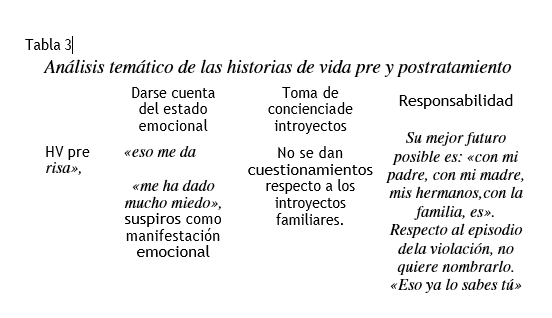
En la evaluación cualitativa mediante análisis temático de las historias de vida pre y post tratamiento, se identificaron mejoras significativas en tres áreas clave:
a) incremento en la conciencia del propio campo experiencial, evidenciado por una transición de descripciones emocionales simples a expresiones más complejas y detalladas en la historia de vida (HV) post tratamiento; b) mayor conciencia del espacio vital, incluyendo el contexto histórico y cultural. Esto se refleja en el cuestionamiento de introyectos familiares y culturales previamente aceptados sin crítica, con un notable contraste entre la ausencia de interrogantes en la historia pre tratamiento y la emergencia de cuestionamientos post tratamiento, particularmente en relación con prácticas como el matrimonio forzado en su país; y c) un incremento en la responsabilidad personal hacia los propios objetivos de vida y la toma de decisiones frente a adversidades. La Tabla 3 ofrece ejemplos específicos de estos hallazgos.
Tabla 3
Análisis temático de las historias de vida pre y postratamiento

Discusión
Como muestran los valores de los índices de no solapamiento, la sintomatología relacionada con el trauma se ve reducida de forma significativa en el caso de Esperanza, lo que sugiere un adecuado funcionamiento de la TG como reductora de la sintomatología traumática (Cohen, 2003).

Manifestación contra el abuso sexual en Madrid. Foto: Isabel Infantes
Se observó un aumento en los niveles de resiliencia después del tratamiento, lo cual se alinea con la teoría de Connor (2006) que sugiere que la resiliencia puede ser un resultado de la recuperación de experiencias traumáticas. Esta mejora en la resiliencia, junto con la reducción de síntomas, indica que se lograron los objetivos establecidos y evidencia la eficacia de la terapia gestalt en la recuperación del trauma en este caso específico. Esta conclusión respalda las ideas de Cohen (2003) acerca del enfoque gestáltico en el tratamiento de traumas. Sin embargo, las dos medidas utilizadas para evaluar el trauma (HTQ y PCL-C) no produjeron resultados consistentes, lo que complica la interpretación de los hallazgos. Es posible que la HTQ no sea la herramienta más apropiada para evaluar el trauma sexual, ya que fue diseñada principalmente para contextos de conflictos militares o tortura. La violencia sexual implica consideraciones culturales específicas que también deben ser tomadas en cuenta en su evaluación. Se han realizado esfuerzos para adaptar las herramientas de evaluación a estas especificidades, como lo demuestran los estudios de Patel et al. (2022).
Los cambios cualitativos reflejan un aumento en la conciencia del campo experiencial y contextual, lo cual está en consonancia con diversas terapias enfocadas en la integración en casos de trauma (Rajan et al., 2022; Robjant et al., 2017). Este aumento podría considerarse un elemento común a todos los enfoques terapéuticos en este campo (Sewell, 2003) y se alinea con los descubrimientos de Foa et al. (1995) sobre la reducción de la fragmentación narrativa y los índices de sintomatología tras una terapia de exposición.
Un enfoque experiencial y humanista, como el que propone la terapia gestalt (TG) para el tratamiento del trauma, puede ser particularmente apropiado. Existe evidencia que sugiere que la verbalización no facilita en igual medida la recuperación de víctimas de violencia sexual, ya que los factores socioculturales vinculados a este tipo de violencia pueden obstaculizar una expresión puramente verbal (Delker et al., 2020).
Limitaciones y prospectiva
Aunque la TG se muestra efectiva en este caso, se necesitan más estudios empíricos en esta línea para demostrar que este enfoque es efectivo en los casos de trastorno de estrés postraumático complejo debido a situaciones de abusos sexuales, incluyendo la posibilidad de un estudio comparativo aleatorio que contraste la eficacia de la TG con otros tratamientos de tipo expositivo, que parecen ser los más utilizados en casos de estrés postraumático (Rothbaum y Schwartz, 2002).
Igualmente, se necesita mayor evidencia en el análisis de datos cualitativos de cambio y contenido narrativo para poder evaluar si la intervención terapéutica ha generado cambios externos de tipo conductual o narrativo independientes de las pruebas psicométricas. A este respecto, sería conveniente introducir categorías ya probadas en la investigación narrativa con el trauma, como son la «redención- contaminación» y la fragmentación (Delker et al, 2020; Foa et al, 1995), así como evaluar los contenidos narrativos de todas las sesiones y no solo los de inicio y final del tratamiento.
Asimismo, también se valorará en un futuro la adherencia de la intervención a los criterios de la TG utilizando la Escala de Fogarty, (Fogarty et al, 2019) y la asociación con mejoras y fracasos en la intervención.

Psicóloga general sanitaria con formación especializada en psicoterapias humanistas, terapia gestalt, bioenergética, psicoanálisis y psicoterapia integrativa. Trabaja en el ámbito social interviniendo en trauma y salud psicológica de mujeres víctimas de Violencia de Género (en la pareja y en contextos de prostitución) y en consulta privada. Actualmente es estudiante de doctorado por la Universidad de Sevilla en la Línea de Clínica y Salud.

Profesor Titular del Departamento de Personalidad, Evaluación y Tratamiento Psicológicos de la Universidad de Sevilla. Doctor en Psicología. Terapeuta Didacta en Terapias Constructivistas. Psicólogo General Sanitario (homologado). Trabaja especialmente en el ámbito de la identidad entendido como sistema de significados y cómo los criterios de identidad constructivista afectan al cambio psicológico y a la evolución del proceso terapéutico.