

INVESTIGACIÓN
Lorena Rodríguez-Campo | Antonio Gómez-Ceto | José Luis Gil-Bermejo
Repercusión del confinamiento por COVID-19 en la presencia de terapeutas gestaltistas en España: un estudio descriptivo
Lorena Rodríguez-Campo | Antonio Gómez-Ceto | José Luis Gil-Bermejo
Resumen
La pandemia de COVID-19 ha afectado dramáticamente al campo de la salud mental y, desde una perspectiva gestáltica, emerge como figura que lo cambia todo. La capacidad de la persona terapeuta en esta nueva situación experiencial de estar en contacto con su vivencia personal y mantener un estado de presencia con el fin de que las personas acompañadas se sientan seguras, confiadas y en disposición para el trabajo a través de un entorno online, provoca la necesidad de conocer cómo se experimenta la presencia terapéutica en línea ante el contexto pandémico y durante el primer confinamiento, teniendo en cuenta sus características sociodemográficas, situacionales y disposicionales, siendo este el objetivo de esta investigación. A partir de una encuesta, realizada a 353 psicoterapeutas gestalt de España, los principales resultados del análisis descriptivo muestran que se ha producido una reducción media de la presencia de la persona terapeuta de un 21,6%.
Palabras clave: presencia terapéutica, terapia online, COVID-19, confinamiento, características sociodemográficas, factores situacionales, elementos disposicionales.
Introducción
Las raíces de la presencia en la relación terapéutica se remontan a los primeros días de la psicoterapia (Geller, 2017b). Los aspectos de la presencia se destacaron en diferentes enfoques terapéuticos, como la atención flotante de Freud, el contacto de Perls (1969) y la relación Yo/Tú de Buber (1966), que ayudan a informar sobre la comprensión actual. May (1983) compartió esta perspectiva, señalando que el constructo de la presencia «se encuentra en terapeutas de diversas escuelas y diferentes creencias» (p.158).
Desde la perspectiva de la psicoterapia gestalt, la noción de presencia ocupa un lugar central tanto en la teoría como en la práctica clínica de los profesionales cualificados. Según Chidiac y Denham-Vaughan (2018), la capacidad de los terapeutas para estar completamente con sus pacientes, participando en un intercambio recíproco de dar y recibir, encapsula el espíritu de la terapia. Esta presencia terapéutica no solo es fundamental para la práctica, sino que también es el catalizador desde el cual emerge el desarrollo de la presencia, como sostienen autores como Fogel (1993), Frank (2016), Stern (2003) y Spagnuolo-Lobb (2016). El enfocarse en la experiencia del momento presente, como señala Ramírez (2011), es crucial para este proceso. Perls et al., (1951, 1954) subrayan que la calidad de la experiencia terapéutica de pende de la habilidad de permanecer presente en el límite de contacto con el entorno, enfatizando el «aquí y ahora» como un indicador esencial de salud.
Para Laura Perls (1994), es esencial la presencia activa del terapeuta para proporcionar el apoyo necesario que permita a las personas movilizar sus emociones y explorar nuevas posibilidades de contacto, con el fin de reorganizar y redirigir su energía para hacer la vida más aceptable. Este proceso es tanto activo como receptivo, facilitando el descubrimiento, el crecimiento y el cambio en la experiencia vital (Perls, Hefferline & Goodman, 1951, 1972). Aquí, la interpretación no encuentra lugar, ya que el terapeuta, desde su presencia, enfoca en la expresión de lo que ocurre en el «aquí y ahora» (Naranjo, 1970), agudizando la conciencia, intensificando la atención y realzando el significado. Esta presencia añade una dimensión interpersonal al proceso, señalando las dificultades, corrigiendo errores de atención y distracciones (Fagan & Shepherd, 2014).
Poco a poco, se va desarrollando la Teoría paradójica del cambio (Beisser, 2014), que sugiere que el cambio ocurre cuando uno se acepta a sí mismo tal como es, y no al intentar convertirse en algo que no es. Este proceso se ve facilitado por momentos específicos en los que, en la persona acompañada, se produce una unión entre conciencia intensificada y expresión, lo que resulta en sentimientos profundos de presencia, claridad en la percepción, resonancia con la experiencia interior y la integridad de la personalidad (Polster, 2014).
Durante los inicios de la cuarentena por coronavirus, los terapeutas experimentaron una disminución significativa en el sentido de presencia, debido al cambio abrupto de las sesiones presenciales a las online, lo que les llevó a enfrentar presiones y ansiedades no solo por adaptarse al ámbito de trabajo virtual sino también por el contexto general (Frank, 2020). Esta situación contextual única subrayó la necesidad de entender mejor los procesos diádicos (Atzil-Slomin y Tschacher, 2020), incluyendo la influencia mutua y la co-regulación emocional entre el terapeuta y el cliente, durante un periodo caracterizado por un trauma global y colectivo (Spagnuolo, 2020; Taylor, 2020).

El objetivo de esta investigación es profundizar en la comprensión de la experiencia de presencia terapéutica por parte de la persona que acompaña, ante el contexto determinante de la relación, pandémico y de primer confinamiento, teniendo en cuenta sus características sociodemográficas, situacionales y disposicionales.

El psiquiatra y gestaltista Arnold Beisser tuvo que lidiar con una enfermedad que lo dejó paralizado
Método
La investigación se ha planteado dentro del período de confinamiento por la pandemia de COVID-19 en España que decretó el gobierno español para limitar los contagios. El estado de alarma se produjo entre el 15 de marzo y el 21 de junio de 2020. El 22 de mayo, se procede al envío de una carta de presentación de la investigación a la Secretaría de la AETG, invitando a las personas asociadas a que cubran el cuestionario online.
Se diseña un estudio de tipo cuantitativo dado el interés en comprender el fenómeno presencia desde el punto de vista objetivo de observadores científicos mediante medidas controladas, buscando datos sólidos, fiables, comparables y repetibles, a través de la recogida de datos mediante cuestionario online, y aplicando, por una parte, el inventario de presencia terapéutica del terapeuta (TPI-T: Therapeutic Presence Inventory) validado por Geller, Greenberg, & Watson (2010), que está compuesto de 21 ítems y se evalúa mediante una escala tipo Likert de 7 puntos.
Por otra parte, se tienen en cuenta las características sociodemográficas siguientes: edad, género, nivel de estudios, lugar de residencia, años de profesión, ámbito profesional de intervención y de carácter, siguiendo tanto el sistema de clasificación del eneagrama (en Naranjo, 2012) como la bioenergética de Reich y Lowen (en Albert, 2014). También se recogió información sobre el número de sesiones terapéuticas realizadas por los participantes y si estas han sido complementadas con apoyo terapéutico y de supervisión.
Finalmente, se analizan factores situacionales y disposicionales vinculados a la situación pandémica y de confinamiento a nivel familiar y de convivencia. Entre otras características, se establece el tipo de vivienda, el número de personas con las
que se convive, el disponer o no de un lugar tranquilo para realizar las sesiones, si se han producido pérdidas de personas significativas por la enfermedad, si se ha estado enfermo de COVID-19, si se ha tenido miedo a la muerte y si se ha temido por la reducción de la cartera de pacientes o del futuro económico de familiares.
Desde un enfoque descriptivo y teniendo en cuenta el objetivo principal de esta investigación, se plantea la siguiente hipótesis (H1): La presencia terapéutica de las personas terapeutas es significativamente diferente tras el comienzo de la pandemia.
Tal como se recoge en la Tabla 1, el proceso de recogida de datos comenzó el 22 de mayo y finalizó el 30 de junio, obteniéndose 353 encuestas. Se reclutaron profesionales de la Psicoterapia y de la Psicología a través de la AETG y a través de contactos telefónicos y de correo electrónico de compañeras de dichas personas asociadas. No se ofreció ningún incentivo y todas las personas participantes completaron todas las encuestas. Por tanto, el muestreo es no probabilístico de conveniencia siendo el universo poblacional los profesionales de la Psicología, Psicoterapia y Terapeutas Gestalt de España.
Tabla 1
Ficha técnica del estudio
| Características | Encuesta |
| Universo | Psicólogos, psicoterapeutas y terapeutas gestalt |
| Ámbito geográfico | España |
| Tamaño muestral | 353 encuestas válidas |
| Diseño muestral | Muestreo no probabilístico de conveniencia |
| Método recogida info | Encuesta online |
| Fecha del trabajo de campo | 22 de mayo al 30 de junio de 2020 |
Resultados
Inicialmente, se realiza un análisis descriptivo de la información obtenida de las tres áreas o bloques de la encuesta mediante el software para análisis estadístico SPSS versión 23,0.
En cuanto a las principales características sociodemográficas de las personas participantes, encontramos que son personas que proporcionan servicios de apoyo mental y que han completado la formación en terapia gestalt ejerciendo sus funciones como psicólogos, psicoterapeutas o terapeutas en España. Con el ánimo de definir el perfil de las personas encuestadas, se recoge en la Tabla 2 que, del total de individuos (n=353), un 71,1% eran mujeres. La edad media ha sido de 49 años, teniendo la persona más joven 27 años y la más mayor 70. De éstos, la mayor parte cuenta con algún tipo de estudios, fundamentalmente estudios universitarios (88,1%). En cuanto al lugar de residencia, principalmente viven en Cataluña (26,3%), en la Comunidad de Madrid (22,9%) y en Andalucía (17,3%).
La media de los años de profesión ha sido de 12,5 años, oscilando entre un año y 43. Los principales ámbitos de intervención en los que trabajan son: clínico (68,3%), social (33,4%) y educación (25,8%). Esta variable es de respuesta múltiple. El número medio de sesiones realizadas durante el confinamiento ha sido de 49. Y más de la mitad de la muestra son supervisados (53,8%) y están en proceso terapéutico (51%).
Tabla 2
Descripción de los participantes según características sociodemográficas
| Variables | (%) |
| Edad | 49 |
| Género Mujer Hombre Otros | 71,1%28,3%0,6% |
| EducaciónSin estudios Estudios primarios Estudios secundariosEstudios universitarios | 4,0%0,6%7,4%88,1% |
| Lugar de residenciaAndalucía Aragón CantabriaCastilla-La Mancha Castilla y León CataluñaComunidad de Madrid Comunidad Valenciana ExtremaduraGaliciaIslas Baleares Islas CanariasComunidad Foral de Navarra País VascoRegión de Murcia Otros | 17,3%3,4%1,4%1,1%1,1%26,3%22,9%6,2%1,1%7,4%3,7%0,3%1,1%3,7%2,3%0,6% |
| Años de profesión | 12,5 |
| Ámbito profesional de intervenciónClínico Educación Social Empresa Artístico Investigación Supervisión Otros | 68,3%25,8%33,4%9,6%11,0%5,7%14,2%19,3% |
| Número de sesiones realizadas | 49 |
| El terapeuta en terapia | 51,0% |
| El terapeuta en supervisión | 53,8% |
| Carácter desde el EneagramaE1 E2 E3 E4 E5 E6 E7 E8 E9NS/NC | 4 5%19,8%11,6%14,7%4.5%11,0%11,0%2,0%10,2%10,5% |
| Instinto Conservación SexualSocial NS/NC | 22,9%18,4%20,7%38,0% |
| Carácter desde la bioenergéticaEsquizoide Oral Masoquista Psicopático Rígido NS/NC | 4,5%14,7%9,9%22,7%37,4%10,8% |
Con respecto a las características situacionales y disposicionales, tal como se puede observar en la Tabla 3, en cuanto al tipo de vivienda, las personas encuestadas, mayoritariamente, residen en un piso (71,1%), siendo este de un tamaño superior a 70m2 (47%). Esencialmente, conviven con otra persona (34,3%), aunque un 17.8% de las participantes no han convivido con nadie durante este período. Un 95.5% ha dispuesto de un lugar tranquilo para realizar las sesiones y, algo menos de la mitad de las encuestadas (46,2%) ya realizaba terapia online antes de este contexto pandémico.
Cabe resaltar, que casi un 12% de las participantes han sufrido pérdidas de personas significativas por el COVID-19. Tan sólo un 4,8% han estado enfermas de COVID-19 y un 21% han tenido algún síntoma. El 31,7% ha tenido miedo a la muerte, un 61,8% han temido por la reducción de la cartera de pacientes y casi un 40% teme por el futuro económico de sus familiares.
Tabla 3
Descripción de los participantes según características situacionales y disposicionales
| Variables | (%) | |
| Tipo de vivienda Piso < 70m2 Piso > 70m2 Casa unifamiliar Chalet adosado Otros | 24,1%47,0%15,3%8,8%4,8% | |
| Número de convivientes SoloCon 1Con 2Con 3Con 4 | 17,8%34,3%17,8%17,0%10,5% | 1.8 |
| Lugar tranquilo para sesiones SíNo | 95,5%4,5% | |
| Sesiones online previas al confinamientoSí No | 46,2%53,8% | |
| Pérdida significativa SíNo | 11,6%88,4% | |
| Enfermo de COVID-19 SíNo | 4,8%95,2% | |
| Síntomas de COVID-19 SíNo | 21,0%79,0% | |
| Miedo a la muerte SíNo | 31,7%68,3% |
| Reducción clientes SíNo | 61,8%38,2% |
| Miedo futuro económico SíNo | 39,7%60,3% |
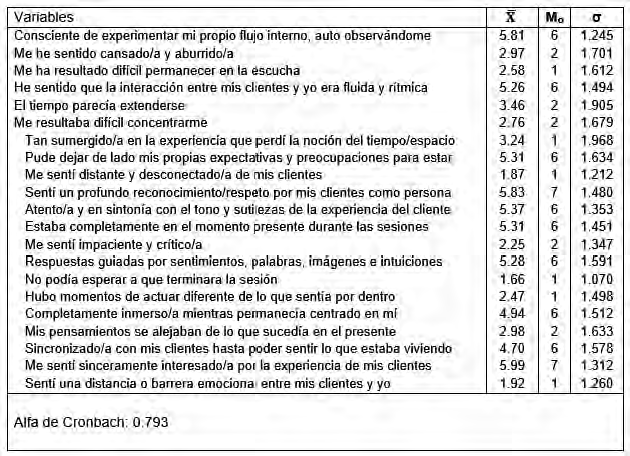
Finalmente, se procede al análisis inicial de la escala de medición de la presencia terapéutica (TPI-T). La Tabla 4 recoge los principales estadísticos descriptivos: media, moda y desviación típica, y se puede observar, como en general, los valores asignados a los distintos ítems alcanzan valores elevados, superiores a cinco o muy próximos. Hay que resaltar que los valores más utilizados han sido los más positivos, ya que la moda de casi todos los ítems es de 6 o 7 puntos, siendo la moda el valor del conjunto de datos que tiene una mayor frecuencia absoluta, es decir, el valor que más se repite de dicho conjunto. Las variables con medias y moda más altas son:
- Me sentí sinceramente interesado/a por la experiencia de mis clientes (media 5,99, moda 7)
- Sentí un profundo reconocimiento y respeto por mis clientes como persona (media 5,83, moda 7)
- He sido consciente de experimentar mi propio flujo interno, autoobservándome (media 5,81, moda 6)
La consistencia interna de la escala medida por el Alfa de Cronbach es elevada (0,793), situándose por encima de los valores recomendados de referencia. Este coeficiente mide la fiabilidad, es decir, si las preguntas de la escala o test están relacionadas entre sí.

Un balcón de Madrid en tiempos de pandemia. Foto de Jairo Vargas
Tabla 4
Presencia terapéutica (análisis descriptivo)
También se deduce que se ha producido una reducción media de la presencia de los terapeutas de un 21,6%, dato significativo (ver Tabla 5), pues indica una merma en la capacidad del terapeuta para llevar todo su ser al encuentro con el cliente y permanecer completamente en el momento presente. A pesar de ello, un 22,9% de las participantes considera que su presencia terapéutica no se ha visto alterada por el contexto pandémico, y este porcentaje aumenta hasta el 32,9% para aquellos que han sufrido una reducción del 5% o menos, lo que supone un tercio de las personas encuestadas. Más aún, el 65,7% de las personas participantes —dos tercios de la muestra— indican que su presencia terapéutica tan solo se ha visto reducida, como máximo, en un 20%, lo que les permite continuar con el servicio terapéutico online a pesar de las dificultades contextuales. Sin embargo, el 90,3% de la totalidad de los psicoterapeutas ha sentido que su presencia se reducía a menos de la mitad. Por todo ello, se acepta parcialmente la Hipótesis 1 (H1).
Tabla 5
Reducción de la presencia (análisis descriptivo)
| Variables | (%) | % acumulado |
| Reducción experiencia de | 21.6 | |
| presencia | ||
| 0% | 22,9 | 22,9 |
| 0% a 5% | 10,0 | 32,9 |
| 10%-20% | 32,8 | 65,7 |
| 25%-50% | 24,6 | 90,3 |
| 50% | 9,7 | 100,0 |
| H1 | La presencia terapéutica de los terapeutas es significativamente diferente tras el comienzo de la pandemia | Se acepta parcialmente |
Discusión
La revisión teórica revela que la presencia terapéutica constituye un fenómeno fundamental y transteórico, esencial en la provisión de una psicoterapia efectiva (Colosimo y Pos, 2015). Dicho fenómeno, al ser un factor común a todos los modelos teóricos, se considera necesario para fomentar la seguridad, fortalecer la alianza terapéutica y aumentar la eficacia terapéutica (Dunn et al., 2013; Geller, 2017a, 2017b; Geller & Greenberg, 2012; Geller et al., 2010; Geller y Porges, 2014; Hayes & Vinca, 2011, 2017; Pos et al., 2011; Rogers, 1980). Por ende, se sugiere que potenciar la presencia terapéutica contribuye a mejorar la calidad de los servicios de apoyo psicológico (Bouchard et al., 2007).
En la psicoterapia gestalt, la presencia es considerada un elemento central de su teoría, ya que se ha sostenido por largo tiempo que los organismos se conectan y diferencian del entorno en el límite de contacto y que la calidad de nuestra experiencia está determinada por cómo se realiza ese contacto. En otras palabras, la calidad de la experiencia depende de la plenitud con la que uno se encuentra presente en el límite de contacto con el medio ambiente (Perls, Hefferline & Goodman, 1951). Además, en el límite de contacto se reconoce la existencia del otro, implicando una conciencia de las diferencias entre uno mismo y aquel otro. Esta es la vivencia del límite entre «yo y el otro», tal como lo describe Laura Perls (1994).
Los resultados de la investigación empírica sobre 353 terapeutas participantes indican una diferencia significativa en su presencia terapéutica tras el inicio de la pandemia, evidenciando una reducción media del 21,6% en su nivel de presencia. Los ítems con mejores puntuaciones en la escala de presencia, cuya consistencia interna ha sido validada, incluyen: (1) sentirse sinceramente interesado por la experiencia de los clientes durante la sesión; (2) tener un profundo reconocimiento y respeto por los clientes como personas; y (3) ser consciente de experimentar el propio flujo interno y autoobservación.
Desde el punto de vista sociodemográfico, la mayoría de personas participantes son mujeres (71,1%), con una edad media de 49 años y nivel universitario (88,1%), principalmente residentes en Cataluña (26,3%) y Comunidad de Madrid (22,9%). En promedio, tienen 12,5 años de experiencia laboral, con una dedicación predominante al ámbito clínico (68,3%). Han realizado un promedio de 49 sesiones, y más de la mitad supervisa y participa en procesos terapéuticos. Casi una quinta parte pertenece al eneatipo E2, siendo el carácter rígido el más común, y la distribución por instinto es bastante homogénea.
En relación con los factores situacionales y disposicionales, es común que vivan en apartamentos (71,1%) de más de 70m² (47%) y, principalmente, convivan con otra persona (34,3%). La mayoría disponía de un espacio tranquilo para realizar las sesiones, y casi la mitad tenía experiencia previa en terapia online antes de la pandemia. Cerca del 12% ha experimentado pérdidas de personas significativas, aproximadamente un 5% ha padecido COVID-19, y un 20% ha tenido síntomas sin desarrollar la enfermedad. Casi un tercio ha sentido miedo a la muerte, dos tercios han temido por la disminución de su cartera de pacientes/clientes, y casi la mitad ha estado preocupada por el futuro económico de sus familiares.
Una de las conclusiones clave de nuestro estudio es la importancia de enfocar los programas de formación en psicoterapia gestalt en fortalecer la capacidad de presencia del terapeuta, la cual se encarna y se transmite a lo largo del proceso terapéutico. Es crucial que los terapeutas aprendan a mantenerse en esta actitud de presencia en el límite de contacto, ya sea este físico, emocional, cognitivo, relacional, espiritual, o una integración de todos estos aspectos. Esto invita al cliente a adentrarse más profundamente en la experiencia y el encuentro relacional, lo cual favorece un aumento del darse cuenta, expande la conciencia y promueve la sanación a través de la relación.
Se identifican varias limitaciones en el presente estudio. En primer lugar, el autoinforme tiene limitaciones para captar la profundidad y complejidad de las experiencias internas sutiles y co-creadas, dado que es una técnica de tipo cuantitativo. Habría sido interesante aplicar técnicas de tipo cualitativo como las entrevistas en profundidad online y/o el focus group online, con el fin de completar el objeto de estudio. Segundo, la utilización de un muestreo de conveniencia limita la capacidad de generalizar los resultados debido a la falta de aleatoriedad en la selección de participantes. A pesar de los esfuerzos por lograr una muestra geográfica y profesionalmente representativa a través del envío de encuestas personalizadas por correo electrónico a escuelas y profesionales de distintos ámbitos, esta limitación persiste. En tercer lugar, no se ha establecido un momento concreto en el que recoger los datos y se han cubierto de manera telemática, pudiendo producirse diferentes sesgos en la recogida de estos. Finalmente, no se ha tenido en cuenta la percepción del cliente y esto sería, algo para tener en cuenta como futura línea de investigación, dado que existe el inventario (TPI-C: Therapeutic Presence Inventory-Client), siendo aconsejable también, el validar, tanto el cuestionario TPI-T, como el TPI-C, en población española. También se podría analizar la influencia del estilo personal del terapeuta en la presencia y/o conocer cómo evoluciona la actitud de presencia a través del proceso terapéutico en función de la alianza.

Fundadora del Centro Presente (A Coruña). Doctora en Administración y Dirección de Empresas(2010). Terapeuta gestáltica y miembro titular de la AETG. Perteneciente a la Comisión de Investigación de la AETG y al Comité Científico de la Gestalt Conference 2023. Profesora del Departamento de Organización de Empresas y Marketing de la Universidad de Vigo (2005-2022) donde ha participado en más de treinta artículos publicados e indexados, veinte capítulos de libros y/o casos para libros y en más de cincuenta congresos nacionales e internacionales.

Psicoterapeuta. Miembro Didacta y Supervisor de la AETG y de la FEAP. Profesor. Educador Social. Formado en psicoterapia integrativa en el programa SAT dirigido por Claudio Naranjo. Formado en gestalt para el Desarrollo de Organizaciones y Sistemas por el Instituto Gestalt DO. Estudió y practicó Chamanismo, Budismo Tibetano y es estudiante y practicante de Dzogchen y otras vías no duales con diversos maestros de tradición, las cuales integra en su trabajo como psicoterapeuta.

Doctor en CC. Sociales y Educativas, Psicólogo Sanitario, Sociólogo y Trabajador Social. Psicoterapeuta gestáltico miembro titular de la Asociación Española de Terapia Gestalt (AETG), y de la FEAP, director de psicodrama, terapeuta EMDR, programa SAT de Claudio Naranjo, constelaciones familiares sistémicas y terapia sistémica relacional, Máster en estudios de género e identidades. Trabajado durante más de 20 años en el acompañamiento a personas ante situaciones de vulnerabilidad psicológica y social, docente en diversas universidades públicas y privadas. Formador en Escuela de Psicoterapia Humanista El Olivo.